Why AI Will Increase Income Inequality (Just Like Every Technological Revolution Before It)
Here's something that gets lost in all the excitement about artificial intelligence: we've been here before. Not with AI specifically, but with the underlying dynamic. A powerful new technology arrives, creates enormous wealth, and most of that wealth flows to the people who were already ahead. If you zoom out far enough, this isn't a flaw in the system. It basically is the system.
First, How Do We Even Measure This?
Before diving into history, it's worth being clear about what "inequality" actually means, because it's one of those words that gets thrown around loosely.
Economists have a few standard tools. The most famous is the Gini coefficient, a score between 0 and 100, where 0 means everyone has exactly the same income and 100 means one person has everything. It's useful, but it has a blind spot: it can smooth over extremes in ways that hide what's really going on. A society with a handful of billionaires and millions of struggling workers can produce roughly the same Gini score as one where poverty is widespread but more evenly distributed.
So researchers also look at things like what share of total income the top 1% captures, or how many times richer the wealthiest are compared to the bottom half. These numbers give you a better sense of what inequality feels like, the actual distance between people at different ends of the spectrum.
Before Farming, Everyone Was (Relatively) Poor Together
Go back far enough, before agriculture, before cities, before anything we'd recognize as civilization, and inequality was almost negligible. Hunter-gatherer bands were small, mobile, and had little ability to accumulate stuff. You can't exactly build a dynasty when you're carrying everything you own on your back.
The richest members of these groups might have had a bit more than the poorest, but "a bit more" is doing real work in that sentence. The gap was somewhere in the range of 5–10x, tiny by any modern standard.1
Agriculture Changed Everything
Farming upended this. Suddenly, land mattered enormously, and land could be owned, controlled, and passed down. Surpluses could be stored. Wealth became something you could accumulate across a lifetime and leave to your children.
For the first time in human history, being born into the right family meant something economically. Landowners and early rulers pulled ahead, while farmers and laborers worked soil they didn't own. The gap stretched to something like 10–30x between the top and the bottom.2
It's easy to think of this as ancient history, but the structural logic, owning the means of production and capturing the surplus, has never really gone away.
Empires Made Inequality Official
As small farming communities grew into empires, inequality stopped being just an outcome and became something closer to a policy. In Rome, in medieval Europe, across most of the ancient world, elites extracted wealth through taxes, rents, and outright coercion. The people at the top didn't just happen to have more. They had systems designed to ensure they kept it.
The gap widened further, to perhaps 20–60x.3 And yet, there were still limits. Economies were local. Even the wealthiest Roman senator couldn't scale his fortune the way a modern tech billionaire can. Geography and the practical limits of production put a ceiling on how extreme things could get.
The Industrial Revolution Removed the Ceiling
The factory era is when inequality stopped being merely severe and started becoming something new: genuinely unbounded.
When machines replaced skilled craftspeople, power shifted decisively from labor to capital. Factory owners and industrialists accumulated wealth at a pace that had no real precedent. Workers faced brutal conditions, long hours, and wages that kept them just functional enough to show up the next day.
The numbers are striking: the gap between the richest and poorest in the industrializing world grew from roughly 70x in 1820 to close to 180x by the early 20th century.4 Inequality didn't just persist through the Industrial Revolution. It scaled along with everything else.
The 20th Century Was the Exception, Not the Rule
After World War II, something unusual happened: inequality actually fell. The middle class expanded across much of the developed world. Living standards rose broadly, not just at the top.
But here's the important thing. This wasn't because technology suddenly became more equitable. It happened because of institutions: strong labor unions, progressive tax systems, public investment in education and infrastructure, and social safety nets. The technology of the period didn't change the underlying dynamic. Politics and policy did.
And once those institutions weakened, as they did from the 1970s onward, inequality started climbing again.5
The Digital Era: Whoever Has Skills and Capital Wins
Computers and the internet rewarded education, technical ability, and crucially, ownership. Routine jobs got automated or shipped overseas. The returns to being highly skilled shot up. The returns to showing up and doing what you were told stayed flat or fell.
The results are hard to look at directly. Today, the top 1% captures roughly 20% of global income. The top 10% holds about 75% of global wealth. The bottom 50% of humanity shares around 2%.6 These aren't anomalies. They're the logical outcome of a decades-long pattern where technology keeps amplifying the advantages of those who already have them.
So What's Different About AI?
AI doesn't introduce a new pattern. It turbocharges the old one, on multiple dimensions simultaneously.
The leverage it provides is extraordinary. One skilled person with good AI tools can now do the work that previously required entire teams. That's great for productivity, but it means the gains flow overwhelmingly to whoever sits at the top of that arrangement: the highly skilled individual, the founder, the company that owns the model.
Building and running powerful AI systems also requires enormous amounts of capital. Training a frontier model costs hundreds of millions of dollars. That immediately concentrates power in a handful of organizations. You can't bootstrap your way into competing with Google or OpenAI from a garage.
And once an AI system exists, it can serve a billion users almost as cheaply as it serves one. The marginal cost approaches zero. That sounds like good news, and in some ways it is, but economically it means the best systems dominate everything, and there's little room for the second-best.
The Same Story, Bigger Stakes
When you lay it all out, the trajectory across human history is almost monotonously consistent:
| Era | Wealth Gap (approx.) | Key Source |
|---|---|---|
| Hunter-gatherer societies | 5–10x | Kohler et al. (2017); Smith et al. (2010) |
| Early agricultural societies | 10–30x | Kohler et al. (2017) |
| Ancient empires | 20–60x | Milanovic, Lindert & Williamson (2011) |
| Industrial era | 70–180x | Bourguignon & Morrisson (2002) |
| Today | 150x+ | World Inequality Report (2022) |
A note on methodology: The multipliers above are approximate top-to-bottom wealth ratios derived from Gini coefficients and income share data across the cited studies. They are estimates, not single figures pulled from one paper. Different methodologies produce different numbers; these reflect a reasonable mid-range interpretation of the available evidence.
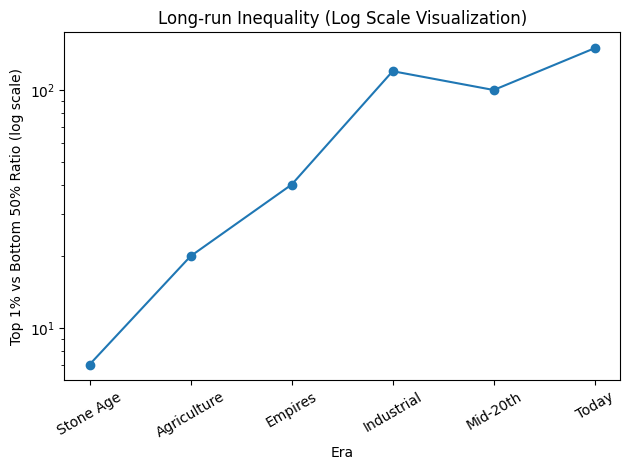
Each major technological revolution has pushed that number higher. The institutions that briefly reversed the trend in the 20th century were remarkable, but they were the exception, not the natural endpoint.
AI looks set to push the number higher again, and faster than previous transitions did. The leverage is greater, the capital requirements are steeper, and the winner-take-all dynamics are more extreme.
How to Actually Build Wealth in the AI Era
The brutal truth of every technological revolution is that there are two kinds of people on the other side of it: those who owned the technology, and those who worked for the people who did. That divide is no longer theoretical. Last week, Oracle sent termination emails to an estimated 20,000 to 30,000 employees, roughly 18% of its global workforce, with no warning, effective immediately.7 Not because the company was struggling. It posted a 95% jump in net income last quarter. Simply because AI made that many people redundant to the math. Amazon, Microsoft, and Atlassian have reached the same conclusion in recent months. This is the opening act.
The cities built on this workforce are already feeling it. Bangalore and San Francisco didn't become global tech hubs by accident. They were built on exactly the layer of work now being automated first: software engineers, operations teams, project managers, support functions. When that middle layer thins out, the restaurants, landlords, and local economies wrapped around it thin out too. What happened to manufacturing towns in the industrial Midwest is coming for knowledge-work cities, just faster and with less warning.
That doesn't mean the outcome is fixed for individuals, even if it is for the system as a whole.
The people who build wealth in this era won't mostly be the ones who work hardest at execution. They'll be the ones who own or direct the systems doing the executing. You don't need to build a frontier model to be on the right side of this. You need to build on top of one. The Gold Rush didn't make miners rich. It made the people selling picks, shovels, and jeans rich. The equivalent today is using AI to build products, automate services, or create leverage in a niche where you already have an edge. A one-person business that needed a team of ten five years ago can now run lean, move fast, and keep most of the margin.
The skills that protect you have also shifted. Knowing how to code or analyze data was the safe bet for two decades. That safety is eroding fast. The value is concentrating in the judgment layer: what to build, who needs it, how to reach them, and when to move. AI handles the execution. The people who figure that out will pull ahead. The ones still optimizing for skills the model can already replicate will find themselves competing with something that doesn't sleep or ask for a raise.
The wealth is coming. History is unambiguous about where it goes when institutions don't keep up: upward. The middle hollows out. The gap widens into something that stops feeling like inequality and starts feeling like a different civilization entirely.
The difference between who captures this moment and who gets left behind comes down to one thing: whether you're using AI as a tool you wield, or accepting it as a force that simply happens to you.
Footnotes
-
Smith, E.A., Hill, K., Marlowe, F.W. et al. (2010). "Wealth Transmission and Inequality Among Hunter-Gatherers." Current Anthropology, 51(1), 19–34. https://doi.org/10.1086/648530 — Found Gini coefficients of roughly 0.17–0.25 for hunter-gatherer populations, very low by modern standards. Also: Kohler, T.A. et al. (2017). "Greater post-Neolithic wealth disparities in Eurasia than in North America and Mesoamerica." Nature, 551, 619–622. https://doi.org/10.1038/nature24646 — Median Gini of 0.17 for hunter-gatherer sites across 63 archaeological locations. ↩
-
Kohler, T.A. et al. (2017). Nature, 551, 619–622. Horticulturalists showed a median Gini of 0.27; larger agricultural societies reached 0.35, consistent with a significant rise in wealth concentration following the adoption of farming. ↩
-
Milanovic, B., Lindert, P.H. & Williamson, J.G. (2011). "Pre-Industrial Inequality." The Economic Journal, 121(551), 255–272. https://doi.org/10.1111/j.1468-0297.2010.02403.x — Estimated Gini coefficients for ancient Rome (~0.43), Byzantium, England 1688, and other pre-industrial societies, ranging from 0.39 to 0.59. Also cited in Kohler et al. (2017), which put the highest Old World ancient Ginis at 0.59. ↩
-
Bourguignon, F. & Morrisson, C. (2002). "Inequality Among World Citizens: 1820–1992." American Economic Review, 92(4), 727–744. The foundational long-run study of global inequality showing a sharp rise through the industrial period. Also: Milanovic, B. (2024). "The Three Eras of Global Inequality, 1820–2020." World Development, 177. https://doi.org/10.1016/j.worlddev.2023.106511 — Confirms rising inequality from 1820 to mid-20th century as the dominant trend of the industrial era. ↩
-
Piketty, T. (2014). Capital in the Twenty-First Century. Harvard University Press. Documents the mid-20th century compression of inequality and its reversal following the weakening of redistributive institutions from the 1970s onward. Also: Atkinson, A.B. (2015). Inequality: What Can Be Done? Harvard University Press. ↩
-
Chancel, L., Piketty, T., Saez, E. & Zucman, G. (2022). World Inequality Report 2022. World Inequality Lab. https://wir2022.wid.world — The top 10% holds 76% of global wealth; the bottom 50% holds 2%; the top 1% captures approximately 20% of global income. ↩
-
CNBC (March 31, 2026). "Oracle cutting thousands in latest layoff round as company continues to ramp AI spending." https://www.cnbc.com/2026/03/31/oracle-layoffs-ai-spending.html — TD Cowen estimated cuts of 20,000–30,000 employees (~18% of Oracle's 162,000-person workforce), with some cuts explicitly targeting roles expected to be made redundant by AI. Oracle posted a 95% jump in net income the same quarter. ↩